
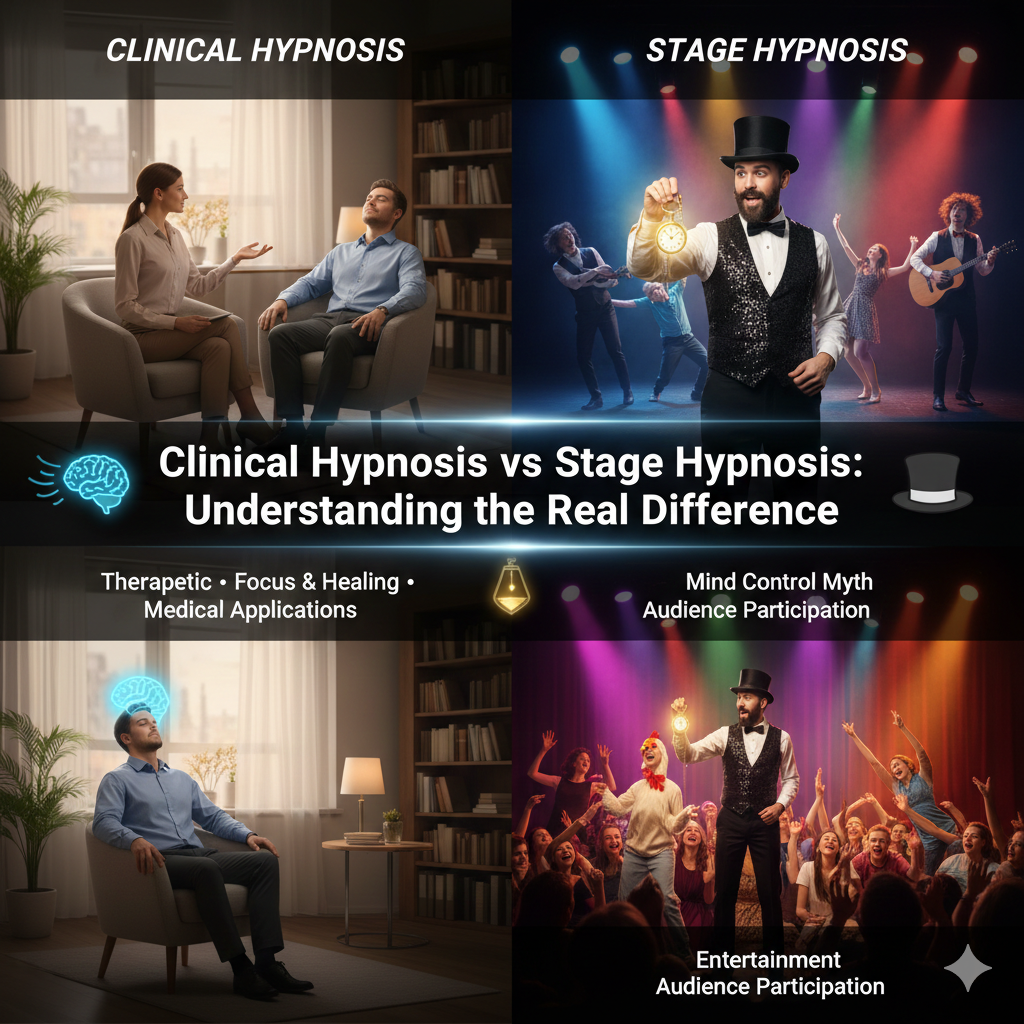

One of the biggest reasons hypnosis is misunderstood is the widespread confusion between clinical hypnosis and stage hypnosis. Although both use the term “hypnosis,” they serve entirely different purposes and operate in completely different environments. When these two are viewed as the same thing, misconceptions naturally arise, often leading people to dismiss hypnosis therapy without understanding its actual value.
To form an informed opinion about hypnosis, it is essential to separate therapeutic practice from entertainment. Clinical hypnosis and stage hypnosis may share surface-level techniques, but their intent, structure, ethics, and outcomes are fundamentally different. Understanding this distinction allows hypnosis to be evaluated fairly and accurately.
What Is Stage Hypnosis?
Stage hypnosis is a form of entertainment. Its primary objective is to engage an audience through dramatic, humorous, or exaggerated behavior. It is designed to be visually engaging, fast-paced, and memorable, often presented in theaters, clubs, or public events.
Participants in stage hypnosis are usually selected based on their willingness to perform and their responsiveness to social influence. These individuals are not randomly chosen. They often volunteer, display extroverted traits, or show a high level of compliance in a group setting. The environment itself plays a significant role. Being on stage, surrounded by an audience, creates social pressure that strongly influences behavior.
In stage hypnosis, suggestion is amplified by expectation. Participants know they are part of a performance. They are encouraged, consciously or unconsciously, to respond in ways that align with the entertainer’s narrative. The resulting behavior may appear spontaneous, but it is heavily shaped by context, motivation, and social cues.
Stage hypnosis is not designed to explore emotional patterns, resolve internal conflict, or support personal development. Its purpose is entertainment, not therapeutic change. Any emotional or behavioral effects that occur are incidental rather than intentional or structured.
What Is Clinical Hypnosis?
Clinical hypnosis, also known as therapeutic or professional hypnosis, is a structured process used within a therapeutic framework. Its purpose is to support mental, emotional, and behavioral well-being through focused attention and guided awareness.
Unlike stage hypnosis, clinical hypnosis takes place in a private, controlled environment. The focus is on the individual, not on performance. Sessions are conducted with informed consent, clear goals, and ethical responsibility. The practitioner’s role is not to impress or entertain, but to guide the individual safely and respectfully.
Clinical hypnosis works by helping individuals access the subconscious patterns that influence their thoughts, emotions, and behaviors. These patterns often operate automatically and may not respond to conscious reasoning alone. Hypnosis provides a calm mental state where these patterns can be observed, understood, and adjusted.
Importantly, individuals undergoing clinical hypnosis remain aware and in control throughout the process. They can speak, move, or stop the session at any time. The experience is internal and reflective, not externally dramatic.
Difference in Intent and Purpose
The most fundamental difference between clinical hypnosis and stage hypnosis lies in intent.
Stage hypnosis aims to create immediate, visible reactions. Its success is measured by audience engagement and entertainment value. There is no concern for long-term impact, psychological processing, or individual well-being beyond the performance.
Clinical hypnosis aims to support internal change. Its success is measured by increased awareness, emotional regulation, behavioral shifts, and improved mental clarity. The outcomes are often subtle and gradual, becoming noticeable over time rather than instantly.
In clinical practice, hypnosis is never used to produce exaggerated responses or public behavior. In fact, dramatic reactions are often discouraged, as they can distract from meaningful internal work.
Control and Awareness
A common myth associated with hypnosis is the idea of losing control. This misconception largely stems from stage hypnosis, where participants may appear to act without awareness or restraint.
In clinical hypnosis, control is never surrendered. The individual remains mentally present and aware throughout the session. Hypnosis does not override judgment, personal values, or moral boundaries. Any suggestion that conflicts with the individual’s beliefs is naturally rejected by the mind.
Clinical hypnosis is a cooperative process. The practitioner guides attention, but the individual’s mind does the work. Awareness may feel different from everyday thinking, but it is never absent.
Ethical Standards and Responsibility
Ethics play a central role in clinical hypnosis. A trained practitioner follows clear professional boundaries, prioritizing client safety, consent, and psychological well-being. Sessions are confidential, respectful, and aligned with the individual’s needs and readiness.
Stage hypnosis operates under entirely different standards. Ethical responsibility is limited to audience safety and performance conduct. There is no therapeutic obligation, assessment, or aftercare involved.
This distinction is important because hypnosis, when used without ethical consideration, can create confusion or emotional discomfort. Clinical hypnosis exists precisely to ensure that hypnotic techniques are applied responsibly and constructively.
The Role of Suggestion in Both Contexts
Suggestion is often misunderstood as control. In reality, suggestion is a natural mental process that influences learning, habit formation, and emotional conditioning.
In stage hypnosis, suggestions are framed theatrically and reinforced by audience expectation. Participants are encouraged to respond in ways that support the performance narrative.
In clinical hypnosis, suggestions are carefully structured and aligned with the individual’s goals. They are never commands. Suggestions function as prompts for the mind to consider alternative responses or perspectives. The subconscious mind accepts or rejects suggestions based on personal relevance and safety.
This difference in how suggestion is used is one of the clearest distinctions between entertainment and therapy.
Long-Term Impact vs Temporary Experience
Stage hypnosis is designed to create a temporary experience. Any behavioral or emotional effects usually fade once the performance ends and the individual returns to their normal environment.
Clinical hypnosis is focused on long-term impact. Sessions are often part of a broader therapeutic process, allowing insights and changes to integrate gradually into daily life. The goal is not to create an intense experience, but to support sustainable change.
This is why clinical hypnosis often feels subtle rather than dramatic. Its effectiveness is reflected in improved self-awareness, emotional balance, and behavioral consistency over time.
Why Confusing the Two Creates Misinformation
When people judge hypnosis based on stage performances, they are not evaluating hypnosis itself, but a form of entertainment that uses hypnotic techniques selectively. This confusion leads to unnecessary fear, skepticism, or unrealistic expectations.
Clinical hypnosis deserves to be understood on its own terms. It is not designed to impress, control, or surprise. It is designed to support thoughtful, intentional work with the mind.
Separating these two forms of hypnosis allows individuals to make informed decisions rather than reacting to assumptions.
A Clear Perspective
Clinical hypnosis and stage hypnosis may share a name, but they are fundamentally different practices. One exists for entertainment, the other for therapeutic support. One relies on spectacle, the other on insight. One prioritizes audience reaction, the other prioritizes individual well-being.
Understanding this distinction is essential for anyone considering hypnosis as a therapeutic option. When hypnosis is viewed through a clinical lens, free from theatrical influence, it becomes clear that it is neither mysterious nor manipulative. It is a structured, ethical, and purposeful method for working with the mind.
For a broader understanding of how hypnosis fits into therapy, including its scientific foundation and practical applications, exploring the complete framework of hypnosis provides es
sential context.